
How to Turn Social Media Followers Into Customers




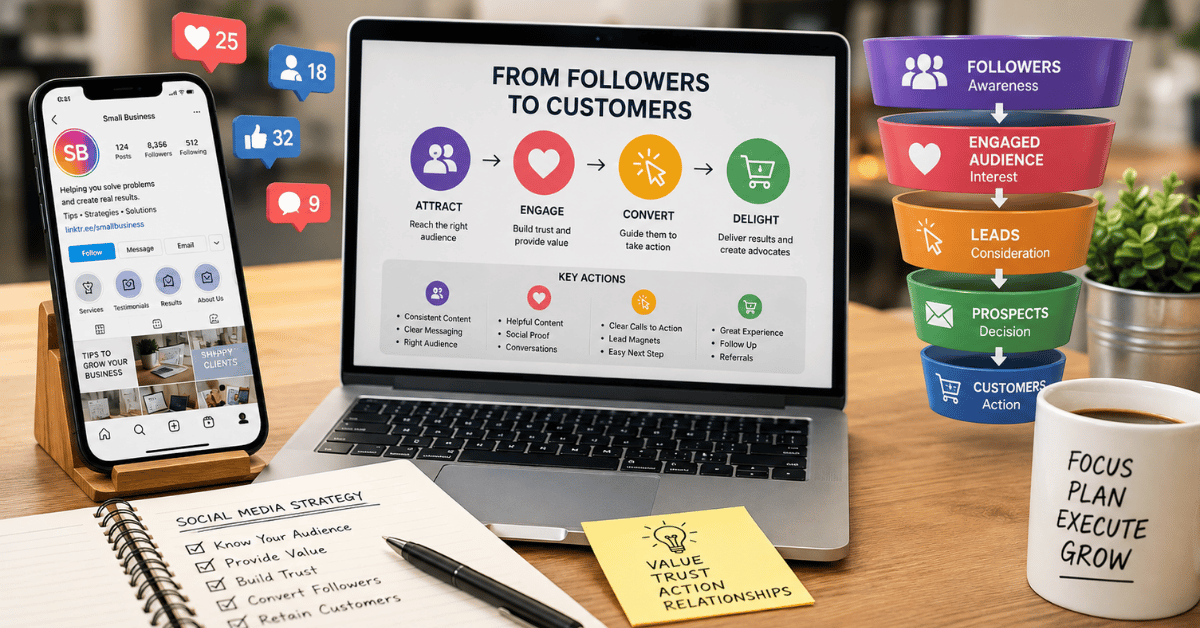
Table of Contents
Learning how to turn social media followers into customers is one of the biggest challenges for small businesses. Many brands are active on Instagram, Facebook, LinkedIn, TikTok, or YouTube, but still struggle to connect that activity with real business results.
They post consistently.
They get likes.
They gain followers.
They may even get good engagement.
But the sales, bookings, calls, inquiries, or store visits do not always follow.
That does not mean social media is useless. It usually means the strategy is missing a clear path from attention to action.
Followers do not become customers just because they follow you. They become customers when they understand your value, trust your business, see a relevant offer, and know what to do next.
Followers Are Not the Same as Customers
A follower is someone who has shown interest. That is valuable, but it is only the beginning.
Some followers may be ready to buy. Others may be casually interested. Some may enjoy your content but not need your service right now. Others may not even be the right fit for your business.
This is why small businesses should not measure social media success only by follower count.
A smaller audience that trusts you, understands what you offer, and takes action can be much more valuable than a large audience that never converts.
The goal is not just to grow your following.
The goal is to build a social media presence that helps people move closer to becoming customers.
Make It Clear What You Actually Do
One common reason followers do not become customers is that they do not fully understand what the business offers.
This happens more often than people think.
A small business may post tips, behind-the-scenes content, client wins, trends, personal updates, or educational content, but never clearly explain the service, product, process, or next step.
If someone visits your profile for the first time, they should quickly understand who you help, what problem you solve, where you operate if location matters, and how they can work with you.
Your bio, pinned posts, highlights, profile links, captions, and content themes should all support that clarity.
People cannot buy what they do not understand.
Create Content That Builds Trust
Social media is often where people decide whether they feel comfortable with your business.
Before someone fills out a form, books a call, or visits your website, they may spend time watching your content, reading comments, checking reviews, or seeing how you communicate.
That is why trust-building content matters.
For a small business, this can include customer stories, educational posts, before-and-after examples, FAQs, process explanations, team content, testimonials, product demonstrations, and behind-the-scenes moments.
The point is not to make every post a sales pitch. The point is to help people feel more confident about choosing you.
A good content strategy answers the questions people have before they are ready to contact you.
Give Followers a Reason to Take the Next Step
Many small businesses post content but never create a clear bridge between the content and the business goal.
A follower may like the post, but then what?
- Should they visit your website?
- Book a call?
- Join your email list?
- Request a quote?
- Send a message?
- Download a guide?
- Visit your store?
- Read a related article?
If the next step is not clear, most people will do nothing.
This does not mean every post needs a hard CTA. But your content should regularly guide people toward a meaningful action.
For example, an educational post can lead to a blog article. A product post can lead to a shop page. A testimonial can lead to a service page. A story can invite people to message you. A case study can invite people to book a consultation.
This is where having a marketing funnel for small business becomes useful. Social media can create awareness and trust, but the funnel helps move people from interest to action.
Use Your Website to Convert the Interest
Social media is not always the best place to complete the sale.
For many small businesses, social media creates interest, but the website does the deeper work of explaining services, building credibility, showing proof, and capturing leads.
That means your profile link matters.
Sending every follower to a generic homepage may not be enough. Depending on the campaign, it may be better to send people to a specific service page, landing page, booking page, article, lead magnet, or contact page.
If your social media is generating clicks but not leads, the issue may not be the platform. The issue may be what happens after the click.
Your website should continue the conversation that started on social media.
If people are visiting your site but not taking action, our article on website traffic but no leads explains why visitors may not be converting.
Turn Followers Into Email Subscribers
One of the biggest risks of relying only on social media is that you do not fully control the relationship.
Algorithms change. Reach fluctuates. Accounts can be restricted. Posts may perform well one week and disappear the next.
That is why small businesses should think beyond followers.
Turning followers into email subscribers gives you a more direct way to stay in touch. It also allows you to nurture people who are interested but not ready to buy yet.
This can be done with a useful guide, checklist, discount, webinar, consultation offer, newsletter, or educational resource.
Once someone joins your email list, you can continue building trust through more intentional communication.
If you already use email as part of your strategy, our guide on email marketing for small businesses explains how it can support stronger customer relationships.
Follow Up With People Who Show Interest
Not every customer journey starts with a form submission.
Sometimes, a potential customer watches your stories for weeks, comments on a post, replies to a poll, clicks a link, sends a short DM, or saves your content.
These signals matter.
A small business should have a simple way to follow up with people who show real interest. That may mean responding to DMs faster, guiding people to the right resource, sending a booking link, or adding qualified contacts to a CRM or email sequence when appropriate.
The key is to avoid letting warm interest disappear.
This is where marketing automation for small businesses can help. Automation can support follow-up, lead organization, email sequences, reminders, and CRM workflows so your team does not have to manage every touchpoint manually.
Work With the Right Creators
Another way to turn social media attention into customers is by collaborating with people who already have trust with your audience.
For small businesses, this does not always mean working with large influencers. In many cases, smaller niche creators are more useful because their audiences are more focused and engaged.
A local creator, industry-specific voice, community page, or niche influencer can help introduce your business to people who are more likely to care.
The best collaborations are not just about reach. They are about relevance.
If your business is exploring creator partnerships, our guide on micro-influencer marketing for small businesses explains how to work with niche creators in a more strategic way.
Track What Social Media Is Actually Doing
If you want to turn followers into customers, you need to know what role social media is playing in the customer journey.
Some people may buy directly after clicking a link. Others may discover you on Instagram, search your business on Google later, read reviews, visit your website, and then contact you.
That is why social media tracking should go beyond likes and followers.
You want to understand whether your content is driving profile visits, website clicks, email signups, form submissions, bookings, calls, or qualified conversations.
This does not need to be complicated, but it does need to be intentional.
Use trackable links when possible. Review website traffic from social platforms. Ask new leads how they found you. Pay attention to which posts lead to real conversations, not just engagement.
Our guide on marketing tracking for small businesses explains how to connect marketing activity with real business outcomes.